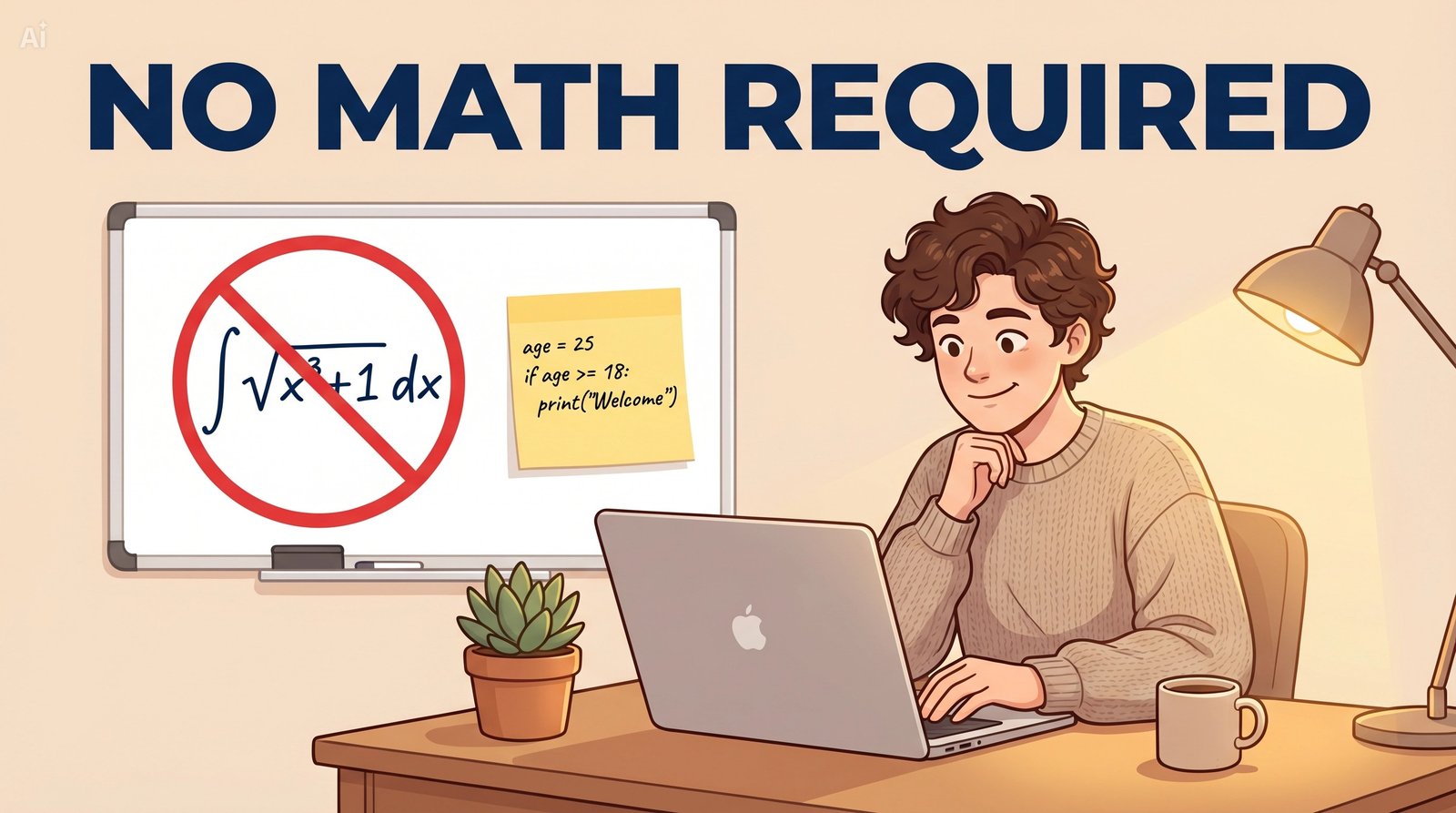
Why You Don’t Need to Be a ‘Math Person’ to Learn Coding (And What You Really Need)
By Khalid EL BAHJA
You’ve probably heard it before: “Coding is all about math.”
Maybe you’ve even thought to yourself: “I’m not a math person, so I could never learn to program.”
Let me stop you right there.
That belief has stopped more talented, curious people from learning to code than anything else. And it’s completely false.
Here’s the truth: You can become a solid, job-ready programmer with nothing more than basic arithmetic (addition, subtraction, multiplication, division) and middle-school logic.
In fact, many professional developers struggle with advanced calculus or linear algebra. They’re still great at their jobs.
So if it’s not about math… what do you actually need?
Let’s break it down.
The 3 Real Skills You Need to Learn Programming
1. Pattern Recognition (Not Algebra)
Programming is largely about spotting repetition and organizing it.
When you see the same action happening three times in a row, a programmer’s brain thinks: “That should be a loop.”
When you see data that looks like a list of names and ages, you think: “That’s an array (or object).”
Real-life example:
Organizing your closet by shirts, pants, and shoes → That’s pattern recognition. No math required.
2. Step-by-Step Thinking (Logical Sequencing)
Computers are incredibly dumb in one way: they do exactly what you say, in exactly the order you say it.
So you have to break down even simple tasks into tiny steps.
Example: Making toast.
-
Math version: “Toast bread.”
-
Programming version:
-
Take bread from bag.
-
Put in toaster slot.
-
Push lever down.
-
Wait 2 minutes.
-
Check if golden brown. If not, wait 30 more seconds.
-
Remove toast.
-
Spread butter.
-
That’s not math. That’s logical decomposition. And you already do it every day.
3. Comfort with Googling (Yes, Really)
Professional developers search Google dozens of times per day.
The skill isn’t memorizing syntax – it’s knowing what to search for and how to read the answer.
Example: “Python how to remove last character from string” → This is a normal, daily query for experienced coders.
If you can type a question into Google, you can solve most coding problems.
New to Googling like a coder?
Our article on The 11 Most Common Coding Mistakes Beginners Make includes a section on how to search for error messages like a pro.
Where Does Math Actually Show Up in Coding?
Let’s be honest: some programming fields use heavy math.
-
Game development (3D graphics, physics engines)
-
Machine learning / AI (linear algebra, calculus)
-
Data science (statistics, probability)
But here’s what most beginners don’t realize:
Those are specializations. You don’t start there. You don’t have to ever go there.
The vast majority of programming jobs – web development, mobile apps, business software, automation scripts, basic backend systems – use only basic math:
| Math Concept | How Often Used |
|---|---|
| Addition, subtraction | Constantly (counters, totals) |
| Comparisons (greater than, less than) | Constantly (if age > 18) |
| Modulo (remainders) | Occasionally (even/odd, every 10th item) |
| Multiplication/division | Rarely (percentages, scaling) |
| Algebra, calculus | Almost never for most roles |
Example:
An e-commerce site calculates total price + tax – discount. That’s 4th grade math.
Facebook’s “Like” button increments a number by 1. That’s kindergarten math.
So unless you dream of building a 3D game engine from scratch, stop worrying about math.
What You Actually Need to Start (Today)
No math degree. No calculus. No advanced statistics.
Just these four things:
-
A laptop or desktop (any cheap one from the last 5–7 years works fine)
-
A willingness to make mistakes (you will, constantly – that’s the job)
-
15 minutes a day (consistency beats cramming)
-
A beginner-friendly language (Python or JavaScript)
Not sure which language to pick?
We compare the most popular options in What’s the Difference Between Python, JavaScript, and C++? (And Which to Learn First) – including a clear recommendation for absolute beginners.
Real People Who Learned to Code Without Being “Math People”
-
A former librarian now builds websites for small businesses. She failed high school algebra twice.
-
A Starbucks barista self-taught Python in 6 months and now automates spreadsheets for a marketing agency. He stopped math after 10th grade.
-
A graphic designer learned just enough JavaScript to add interactive elements to her portfolios. She always hated math.
They’re not geniuses. They’re not “math people.”
They just started.
Inspired by real stories?
Our article I Asked 5 Developers How They Learned to Code – Their Answers Will Surprise You shares more journeys from people who began exactly where you are now.
Your First No-Math Coding Exercise
Let’s prove it. Copy this into any free online Python editor (like Replit):